
Research supporting SunSolve Yield
SunSolve Yield is the same physics engine as SunSolve Power, scaled from the cell to the system — so the evidence runs from laboratory measurement of single devices through to field measurement of whole arrays.
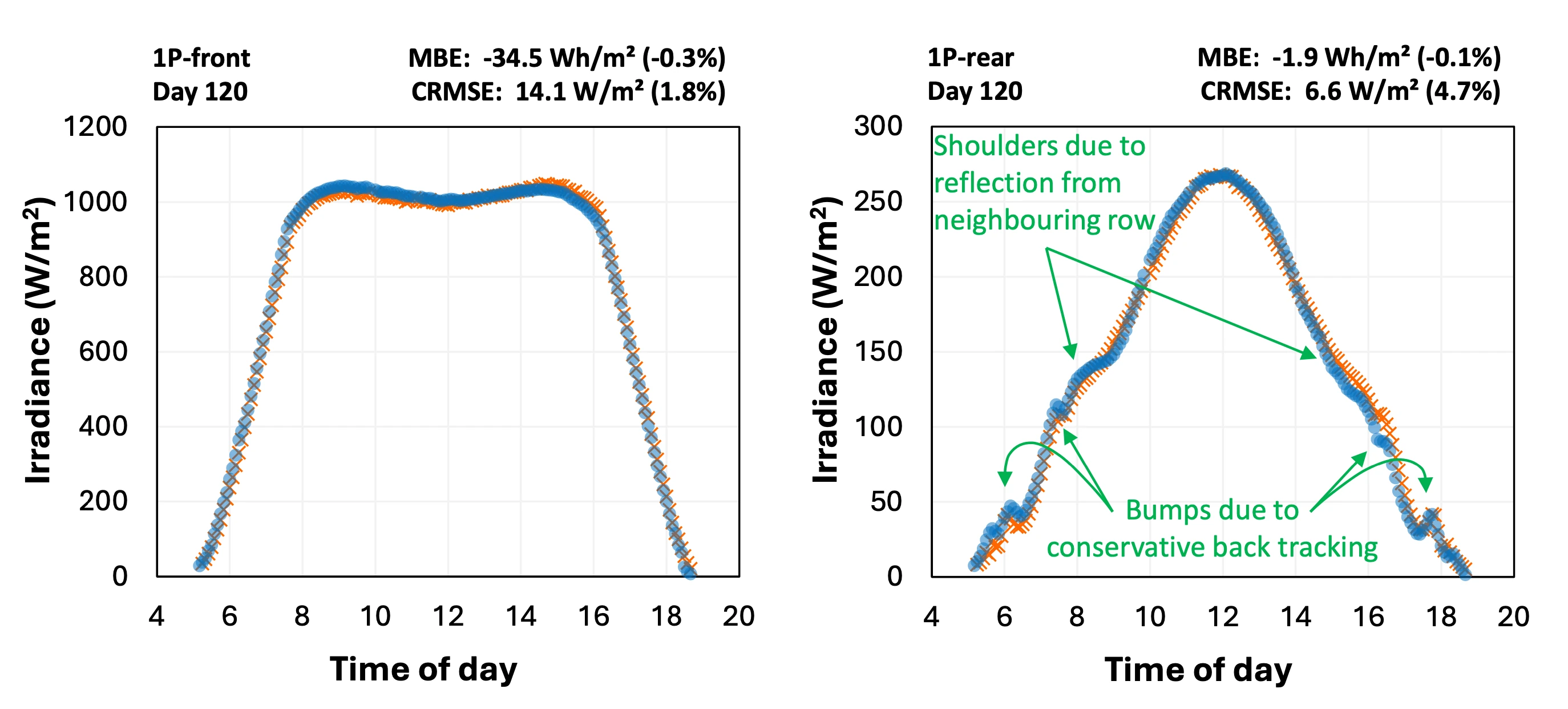
Close agreement with measurement on a bifacial tracker
In a collaborative study, FTC Solar and PV Lighthouse found that SunSolve Yield accurately represented the optics of a solar tracker [1, 2]. The graphs above plot simulated and measured irradiance at the front and rear of a bifacial 1P tracking system on a sunny day.
As demonstrated by the graphs, and by the low MBE and CRMSE, there was very close agreement between simulation and experiment. In addition to predicting the general rise and fall of the irradiance, the ray tracing matched second-order effects caused by two complications: a conservative backtracking algorithm that allowed light to fall between rows early and late in the day, and light reflecting from the front side of neighbouring modules onto the rear plane-of-array detector.
The same instrumented FTC Solar campaign produced both the optical results here and the thermal results in section 04 — one site yielding two independent kinds of validation. The published paper [2] is titled for the thermal work; the irradiance comparison appears within it.
Simulated vs measured front and rear irradiance, pyranometers at torque tube axis and plane of array
One instrumented bifacial 1P single-axis tracker site, FTC Solar
Clear-sky day, resolved through the day; drawn from a longer measurement campaign
Ray-tracing optics as published, 2022
Independently reviewed
ICF Resources, acting as independent engineer, has reviewed SunSolve Yield's general simulation approach and the method by which the four PVsyst bifacial correction factors are derived from it. ICF assessed both as “appropriate and consistent with industry-accepted PV modeling practices.”
The review was commissioned by Nextpower. It examines the method rather than validating it against field measurement, and it records the assumptions and limitations of the approach alongside its conclusions.
Methodology review of the simulation approach and the factor derivation
Desk review by ICF Resources, commissioned by Nextpower
Completed 2026
Current factor derivation procedure. Not a field validation
We can send the full report to developers, EPCs, IPPs and independent engineers on request.
Bifacial factors carried into PVsyst
SunSolve Yield is frequently used by developers to determine the bifacial factors required as inputs for PVsyst and other yield programs like SolarFarmer, PlantPredict and SAM.
The approach to determine those factors was evaluated in a collaborative study between Array Technologies, CFV Solar and PV Lighthouse [3, 4]. SunSolve simulations were first validated against an Array Technologies single-axis tracker at CFV Solar's test facility, then used to determine the bifacial inputs specific to Array's tracker. After inserting those factors into PVsyst, Array Technologies concluded that they could match the net energy produced by two bifacial systems over a 16-day test period to within ±0.3%.
Net energy of two bifacial systems, measured vs PVsyst driven by SunSolve-derived factors
One site, one tracker: Array Technologies single-axis tracker at CFV Solar's test facility
16-day test period
The derivation procedure as it stood in 2020. The factor values are specific to that tracker and site and are not transferable
The 2020 tracker and procedure are not necessarily comparable with factors generated today. Why the values do not transfer between projects is set out on the PVsyst bifacial factors page.
Module temperature error reduced by a factor of two to three
SunSolve Yield contains the option to include advanced thermal models that extend the standard Faiman model used in most software. In a collaborative study with FTC Solar, these models were found to reduce the error in the simulated module temperature by a factor of two or three. The FTC Solar results come from the same instrumented campaign as the optical validation in section 01. 5B has also used SunSolve's thermal models in a simulation of its Maverick system; that work is simulation only.
The figure below plots predicted and measured module temperature Tm from the study with FTC Solar on single-axis trackers [2]. Model 5 illustrates the best fit achievable with the standard Faiman model, amounting to an uncertainty in predicted Tm of ±6.6 °C. The advanced models greatly reduce that uncertainty; for the most advanced model it was just ±2.8 °C. The quoted error represents the 95% confidence interval.
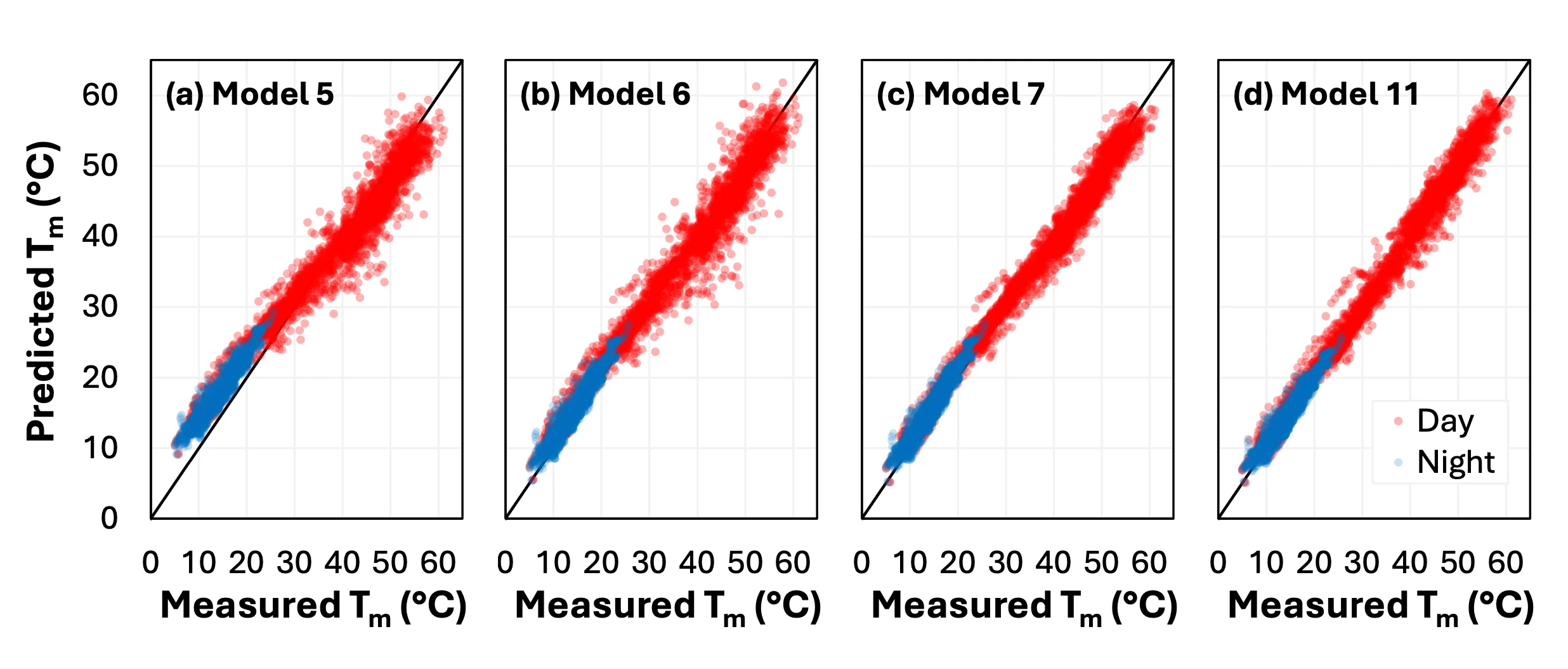
Simulated vs measured module temperature, Faiman model against the advanced models (FTC Solar)
FTC Solar single-axis trackers (measured); 5B Maverick (simulation only)
Continuous instrumented measurement at FTC Solar
Thermal models as published, 2022 (FTC Solar)
LONGi tested the engine against their world-record cell in Nature Energy
LONGi compared simulations and measurements of their world-record silicon heterojunction solar cell in a paper published in Nature Energy [5]. As the figure below shows, their simulated EQE (edge of the blue area) agreed with their measurements (red symbols) at all wavelengths. This gave them high confidence in their SunSolve loss analysis.
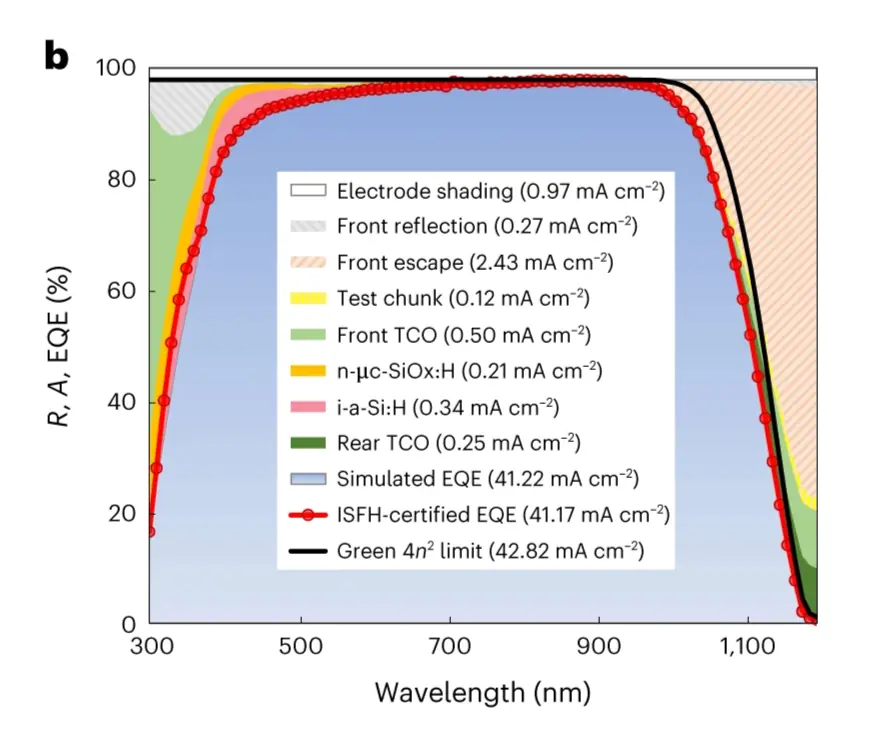
Simulated vs measured external quantum efficiency across the spectrum
One device: LONGi's 26.81%-efficient silicon heterojunction cell, measured by LONGi
Laboratory measurement, published 2023
Cell-level optical and electrical simulation. Not a system yield validation
The same framework, tested across the literature
SunSolve Yield uses an optical ray-tracing framework first created by PV Lighthouse in 2015. Since then it has been tested by researchers at leading PV companies and institutes, who have together published over 100 academic papers applying and validating their SunSolve simulations of PV cells, modules and systems. The list is on the publications page, where the count can be checked.
Differences with PVsyst and other conventional yield models
A yield forecast contains many interrelated models: for the solar spectrum, for the transposition of light from the sky to the module, and for the electrical and thermal behaviour of the cells and modules.
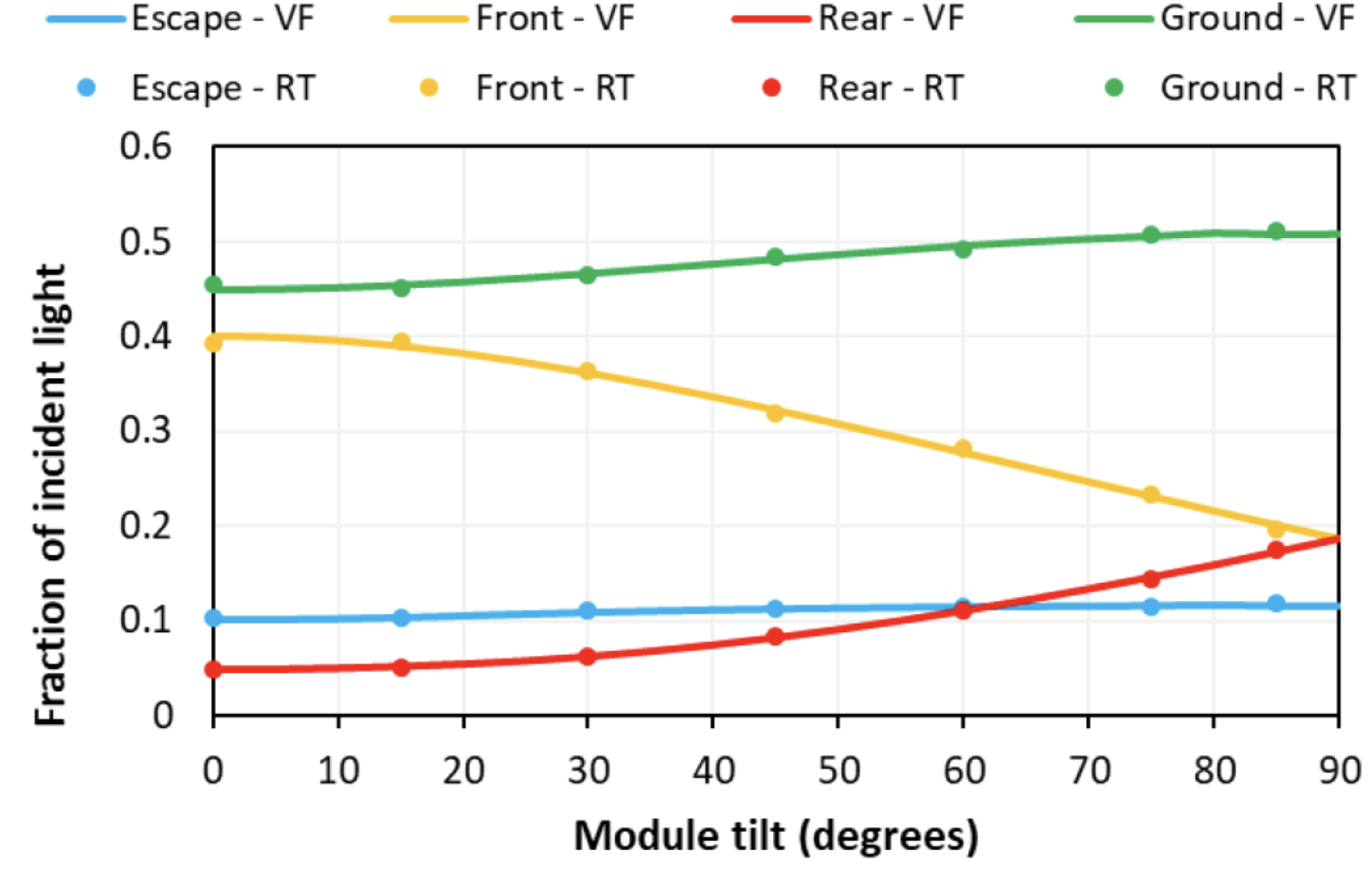
SunSolve Yield gives identical results to PVsyst for ideal conditions, such as the central monofacial module in an infinite field with no shading or mismatch. A basic test for a ray-tracing engine is whether it reproduces such a case: with no structural supports, no gaps between modules and an isotropic light source, the view-factor method gives the exact irradiance on the front and rear, providing an answer against which the ray tracing can be checked. It does, which shows the two are consistent where their assumptions coincide.
But as a scenario becomes more complex — bifacial modules, shading and reflections from structural supports, spacing between modules — the results from SunSolve Yield increasingly diverge from PVsyst. We explain and quantify the sources of difference in this presentation [1].
References
- [1] McIntosh, K.R., Abbott, M.D., Sudbury, B.A. “Differences between advanced and conventional models in bifacial yield simulations,” PVPMC workshop, Salt Lake City, 2023. Presentation
- [2] McIntosh, K.R., Abbott, M.D., Sudbury, B.A., Aneja, S., Bowman, M., Brown, L., Kahane, B., Nicholas, N. and Nolde, K., “The influence of wind and module tilt on the operating temperature of single-axis trackers,” 2022 IEEE 49th Photovoltaic Specialists Conference (PVSC), pp. 1033–1036. Contains both the optical and thermal results from the FTC Solar campaign. PDF
- [3] Crimmins, J., McIntosh, K.R., Creasy, L., Lee, K. “Field testing meets modelling: validated data on bifacial solar performance,” White Paper, CFV Solar, PV Lighthouse, Array Technologies. White paper
- [4] Passow, K., Lee, K., Creasy, L., Sharp, J., Nagyvary, J., McIntosh, K.R., Abbott, M.D., Sudbury, B.A., Crimmins, J. and Zirzow, D., “Estimating bifacial loss factors for annual utility scale simulations,” 2020 47th IEEE Photovoltaic Specialists Conference (PVSC), pp. 2348–2349.
- [5] Lin, H., Yang, M., Ru, X. et al. Silicon heterojunction solar cells with up to 26.81% efficiency achieved by electrically optimized nanocrystalline-silicon hole contact layers. Nat Energy 8, 789–799 (2023). doi.org/10.1038/s41560-023-01255-2
SunSolve Yield
The only simulation environment that models the physics from solar cell right through to annual yield.
Check the method yourself
Where the four correction factors come from, and why they do not transfer between projects.
Over 100 papers applying and validating SunSolve simulations, including the LONGi paper [5].
The instrumented single-axis tracker study behind both the optical and thermal results [2].