
PVsyst Correction Factors: Where Do You Get Yours?
Ground albedo drives bifacial gain — but it's the bifacial correction factors that are hardest to justify. Our latest release generates a full audit trail for every PVsyst correction factor, automatically.
· Ben Sudbury · research · 6 min read
If you’re running PVsyst for a bifacial project, you need values for the structure shading factor, the shed transparent fraction, the ground albedo, and the rear mismatch loss. Where do those numbers come from?
For a lot of projects, the answer is some combination of tracker-manufacturer defaults, rules of thumb, or values borrowed from a previous site. That’s been the norm for years. But as bifacial systems have come to dominate new utility-scale installations and IEs have started scrutinising these inputs more closely, I think it’s worth asking whether that approach still holds up — because the variation in these factors is larger than most people assume.
Albedo Is Only Part of the Story
The biggest driver of bifacial gain is obviously the ground albedo — and you can set that in PVsyst yourself. To illustrate the range, I ran three simulations this week for the same system in Quebec at a GCR of 0.35, changing only the ground surface:
- Brown gravelly loam: 3.75% bifacial gain
- Limestone gravel: 7.13%
- Snow: 17.51%
That’s a big swing. Determining an appropriate albedo is a difficult problem in its own right — it varies spatially across the site, changes with time, and is spectrally dependent — and is a topic for another blog. This blog concerns three other factors that influence the bifacial gain: structural shading, transmission, and rear mismatch. These depend on the 3D geometry of the mounting structure — torque tubes, purlins, clamps, module spacing — and on how the resulting non-uniform rear irradiance interacts with the electrical circuit of the module. PVsyst’s view-factor model doesn’t model these effects; it relies on you to provide correction factors that account for them.
The Structural Factors Vary More Than You’d Expect
This is where defaults get you into trouble. The structure shading factor and rear mismatch loss aren’t constants you can look up — they change with the system design and the site conditions.
Change the module type on the same tracker and the structure shading factor moves. Move the same system to a different location and the combination of different shading geometry and environmental conditions changes the result — I ran the limestone gravel case in both Quebec and Sydney at the same GCR, and got 7.22% bifacial gain in Quebec versus 6.59% in Sydney. Same system, same ground surface, different result. The albedo is identical in both cases; the difference is driven by how latitude and weather — particularly the diffuse fraction — affect both the correction factors and the bifacial gain.
The figure below — generated from an example SunSolve report for a tracker system in Pretoria — shows how much the hourly values of each factor vary compared to the annual energy-weighted average (horizontal line). The rear shading factor, transparency factor, and rear mismatch factor all respond strongly to diffuse fraction, and a single annual default — even if it was right on average — will overestimate the loss in some conditions and underestimate it in others.
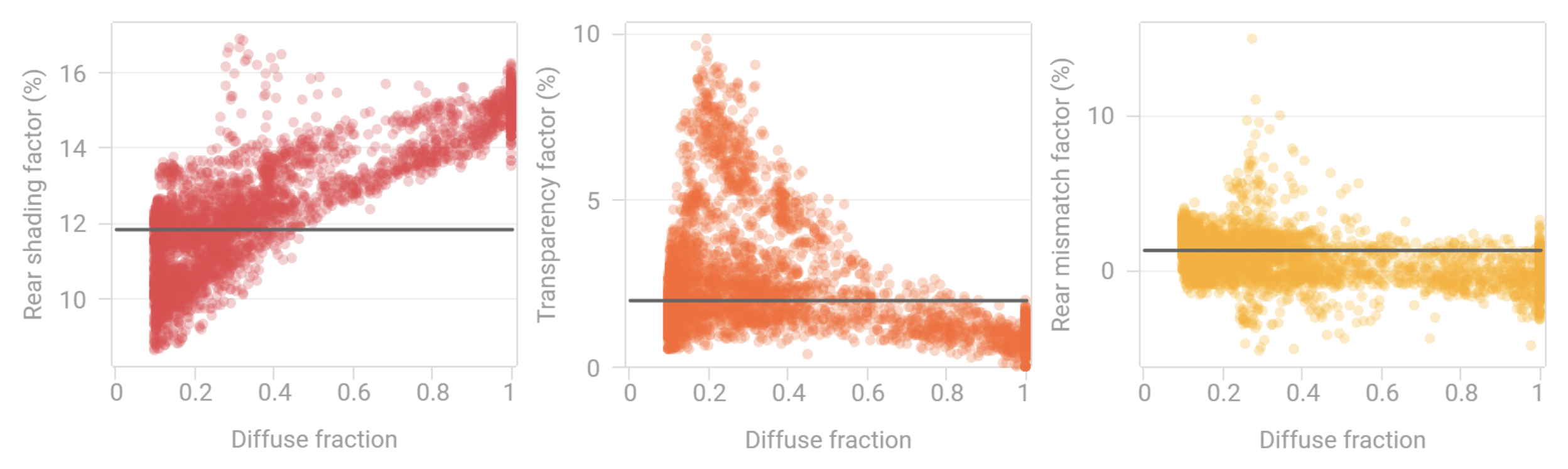
The annual energy-weighted average is the input needed by PVsyst. But that single number is smoothing over significant time-step variation, and a default derived for a different tracker or a different site can easily be off by 5–8% absolute.
What Does This Cost?
For a typical tracker system with a bifacial gain of around 6%, the structural correction factors (shading, mismatch, transmission) would need to be off by roughly 5–8% absolute to produce a 0.3–0.5% error in total yield. That’s plausible — it’s the kind of error you get from applying PVsyst 8’s default structure shading factor of 5% when the actual value is closer to 10%, or using a default rear mismatch loss of 10% when the site-specific number is 2%.
On a 500 MW project with a 20% capacity factor and a revenue rate of $40/MWh, 0.3% of annual yield is $105K per year. Over a 25-year project life, even a small systematic error compounds.
What’s New: Automated PVsyst Correction Factor Reports
We’ve been generating physics-based PVsyst correction factors since we first established the procedure with Array Technologies in 2020, and automated the calculation last year. But the consistent feedback from our larger customers has been: the numbers are great — we need to show how we got them.
Today’s release addresses that directly. SunSolve Yield now generates a complete PVsyst Correction Factor Report alongside the factors themselves — automatically, in as little as a minute. The report includes:
- All annual factors — structure shading factor, shed transparent fraction, ground albedo, front and rear mismatch, and bifacial gain.
- System definition — tracker type, GCR, module model, structural components, layout, tilt range, backtracking.
- Weather data — source, location, monthly GHI, DHI, diffuse fraction, temperature, wind speed.
- Daily and time-step trend charts — how each factor varies across the year and responds to diffuse fraction and zenith angle. You can see the seasonal patterns discussed above and sanity-check the results at a glance.
- Full methodology — how SunSolve isolates each physical mechanism through controlled simulations, the equations used, and a mapping table between SunSolve outputs and the corresponding PVsyst input fields.
The idea is that you can hand this directly to an IE or lender’s technical advisor. The methodology is documented, the inputs are transparent, and the trend charts show that the physics makes sense for that particular site and system.
Works With More Than PVsyst
I’ve focused on PVsyst here because that’s where most of our customers use these factors. But the underlying methodology applies to other programs too — PVLib, SolarFarmer, PlantPredict, and others. The specific factor definitions may vary slightly between implementations, so contact us if you’d like to discuss how to apply the approach to your tool of choice.
This builds on the approach validated with Array Technologies and CFV Solar, which established the SunSolve procedure as the foundation for bankable modelling of bifacial power plants. We’ve been doing this across hundreds of projects since 2020. The report just makes the justification as straightforward as the calculation.
Getting Started
The PVsyst Correction Factor Report is available now to all SunSolve Yield subscribers — generated automatically as part of the standard workflow.
If you’re currently using defaults or manufacturer-supplied numbers and want to see what site-specific factors look like for one of your projects, contact us for a supported trial. We’ll run it with you.
Acknowledgments
Thanks to our technical advisory committee and early-access customers whose feedback shaped the report format.
This work was supported by funding from the Australian Renewable Energy Agency (ARENA). The views expressed herein are not necessarily the views of the Australian Government, and the Australian Government does not accept responsibility for any information or advice contained herein.