
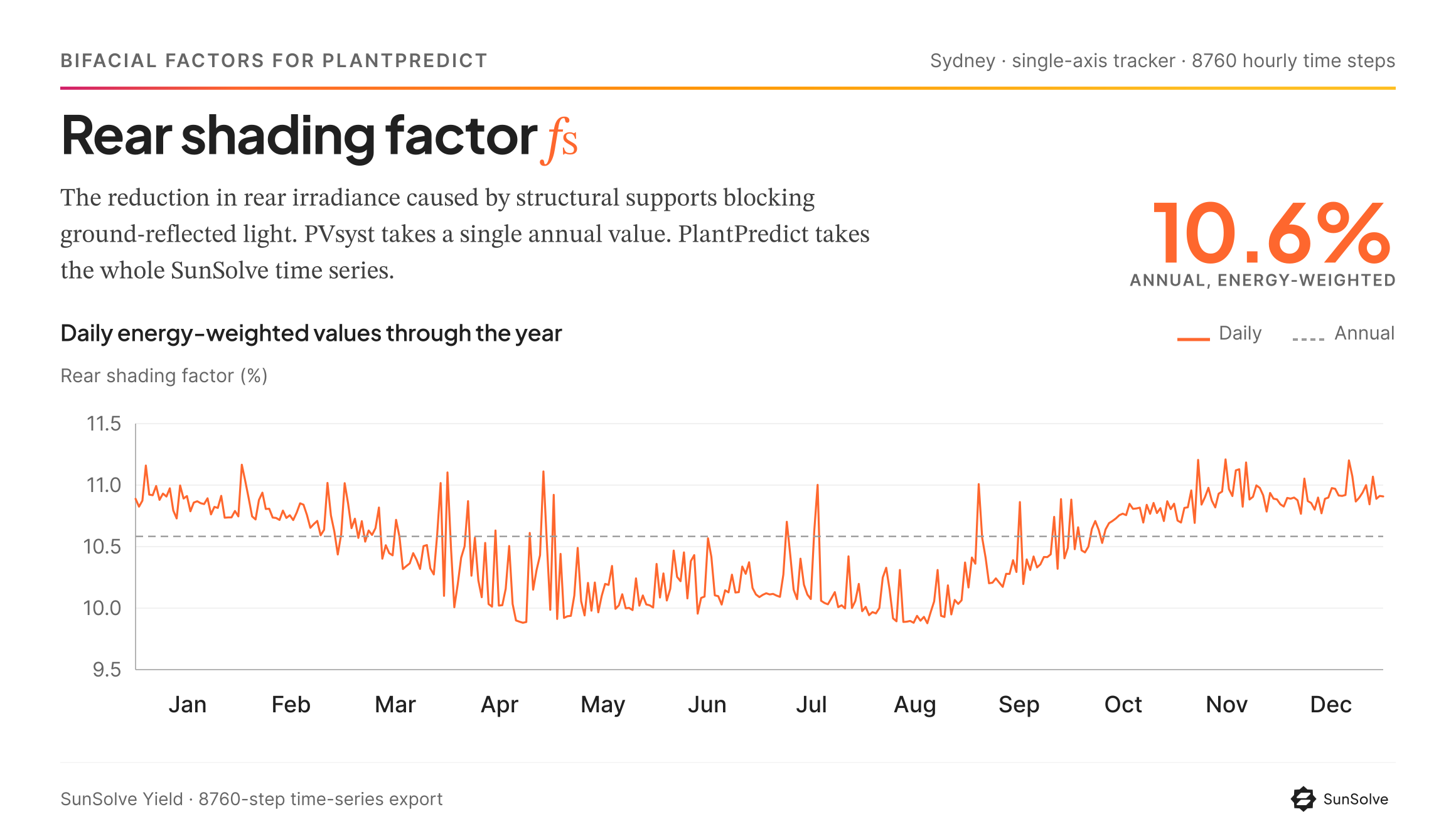
SunSolve models the system from first principles: ray tracing for the optics, a circuit model for every cell, and a solar spectrum computed for each timestep. The bifacial factors it provides to yield tools — the structural shading factor, the transmission factor and rear-side mismatch — are time-averaged outputs of that simulation. PVsyst accepts each factor as a single annual value. PlantPredict can now import the factors at every timestep, from a file exported directly by SunSolve.
In March we noted that the annual average required by PVsyst conceals significant time-step variation. PlantPredict’s import removes the need to average.
Yearly averages miss the details
An annual bifacial factor is an energy-weighted average. It preserves the annual rear-side energy but not its distribution in time. The rear shading, transmission and mismatch factors all depend on sun position and diffuse fraction, so their hourly values deviate substantially from the annual figure and their daily averages vary with season.
That matters for two reasons. First, a growing share of analyses depend on when the energy arrives, not only how much arrives: battery sizing and dispatch, and revenue under time-varying prices, both need the hourly profile to be right. Second, even the annual figure can depend on the hourly values. Inverter clipping is one example. Calculating clipping relies on the power at each timestep being right, so errors in the timestep values can change how much clipping is predicted across the year. How much this matters is likely to vary from site to site, and with SunSolve and PlantPredict together you can now work it out for your own project.
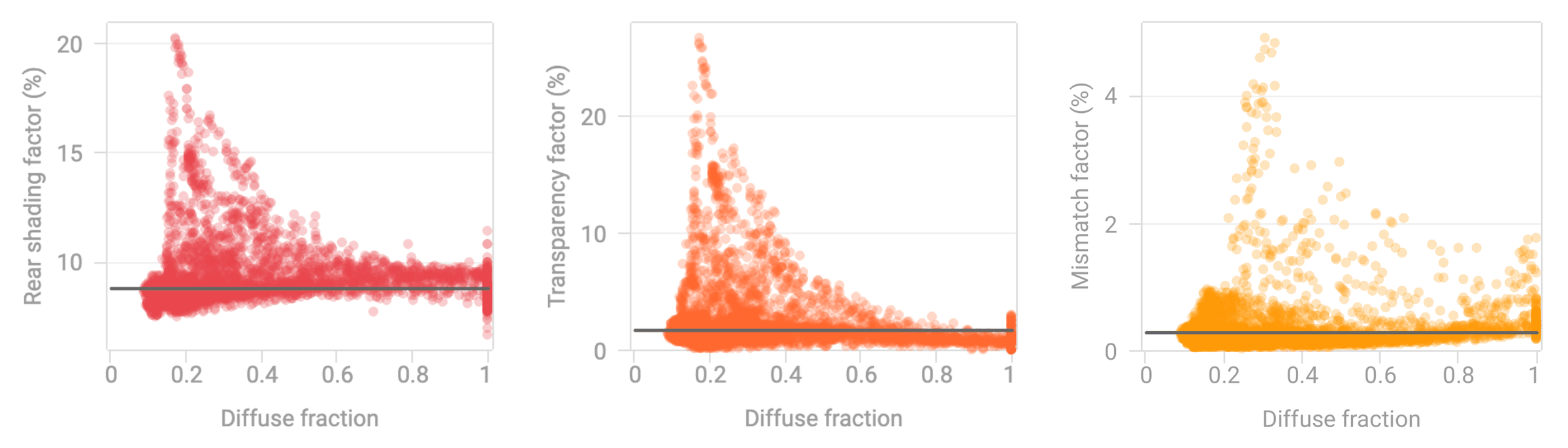
The chart above, taken from the report SunSolve generates for PlantPredict, shows the spread of timestep values about the annual average for a tracker system in Golden, Colorado. PlantPredict’s timestep import applies each factor at the timestep for which it was calculated. No temporal averaging is applied.
Backed by validation and a report you can hand over
SunSolve’s derivation of hourly bifacial factors has been used by the industry for several years. The method is described in a white paper, and the ray-tracing engine behind it has been compared against field measurements and published in peer-reviewed journals.
Every analysis simulation produces an automated report that describes the derivation method and presents the hourly factors for inspection and scrutiny, alongside the system configuration and weather data used. It is intended to be provided directly to an independent engineer or a lender’s technical advisor.
The method behind the factors is set out in full on our bifacial correction factors page.
How PlantPredict and SunSolve fit together
When deriving bifacial factors, the two tools model the plant at different scales. SunSolve works at the unit-system level, with the dimensions of every structural component (posts, clamps, torque tubes and frames), the ground surface beneath the array, and the electrical layout of the modules down to the cell circuit and bypass diodes. PlantPredict works at the plant level, representing the balance of system — inverters, cabling and transformers — the way trackers connect to them, and undulating terrain across the site.
The workflow follows from that division. You build a detailed unit-system in SunSolve that captures the structure, the ground and the module electrical layout. SunSolve then runs a set of simulations over that unit-system to derive the bifacial factors, and writes them out as a time series that PlantPredict can load directly. The same run produces the automated report described above, so the numbers loaded into PlantPredict can be justified to a reviewer.
The integration joins PlantPredict’s other specialist integrations, such as PVRADAR for soiling and PowerUQ for uncertainty analysis, each of which replaces a default with a modelled value. Our documentation sets out the steps for determining bifacial inputs with SunSolve.
Get started
Our bifacial factors page sets out where these numbers come from, and includes a sample report showing how they moved across a year at a real site. If you would like to see the same for one of your own projects, get in touch and we will run it with you.